


loading...

Free shipping for orders above £159.00

Bath Towel vs Beach Towel: What’s Different?

Bath Towel vs Beach Towel: Size, Weave and Use Compared

Bath Towel vs Beach Towel: Size, Weave and Use Compared

Bath Towel vs Beach Towel: Size, Weave and Use Compared

Products and materials selected for bath towel vs beach towel

Products Used

Products and materials selected for bath towel vs beach towel

A bath towel and a beach towel can both dry skin, but they are designed around different environments. In a bathroom, softness, absorbency and comfort after a shower usually come first. At the beach or pool, coverage, visibility, transport, repeated wetting and contact with sand, salt or chlorine become part of the decision. The label is useful; the towel’s actual size, weight, weave and care instructions are more useful.

The best answer to bath towel vs beach towel is therefore not that one category is universally better. It is that each construction balances performance differently. A plush terry bath towel may feel luxurious at home but occupy more room in a bag. A large artist beach towel may work beautifully beside a pool and still be suitable after a bath. Start with where the towel will be used, how it will dry between uses and what you need to carry.

These are tendencies, not fixed standards. Some beach towels use plush terry, some bath towels are light and compact, and many designs deliberately cross the boundary. Read the product specification rather than relying on the product name alone.

A bath towel usually moves through a predictable cycle: dry the body, hang on a rail, air between uses and return to the wash. This makes skin feel and water uptake central. A looped terry surface exposes more yarn and creates the familiar soft, tactile hand associated with bath linen. A denser construction can feel generous, provided the room has enough airflow and the towel is spread out rather than left folded while damp.

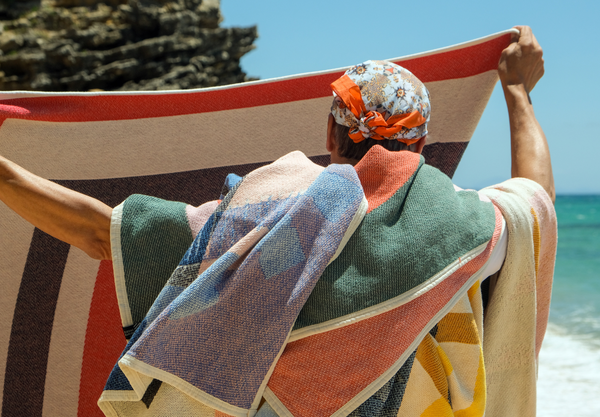
A beach towel has a more complicated job. It may dry the body, cover a lounger, create a clean surface on pebbles or sand, provide temporary shade for belongings and become a wrap on the walk home. It also has to travel out and back, sometimes while wet. Size and visual character can therefore matter as much as pure absorbency.

The ZigZagZurich organic bath towel collection is described as long-staple organic cotton woven in Portugal for a plush, absorbent feel. The artist beach towel and mini-blanket collection includes designs intended for the beach, garden, picnic and home. Those ranges illustrate two different starting points: a coordinated bathroom ritual and a textile that moves between settings.
Explore Collections

Bath Towel vs Beach Towel: Size, Weave and Use Compared

Size: compare real dimensions, not category assumptions

There is no single universal beach towel size or bath towel size. Terms such as bath sheet, bath towel, beach towel, XL towel and mini blanket can overlap between brands. Check both measurements on the individual product page and compare them with your body, storage and travel needs.

For home use, ask whether the towel wraps comfortably, clears the floor when hung and fits the available rail. A very large towel can feel enveloping but may crowd a small hook or overlap when two people share one rail. That slows airflow through the wet fabric.

For outdoor use, length and width affect both body coverage and the area between you and the ground. Also calculate the packed consequence: a larger rectangle contains more material at the same GSM, so it will generally weigh more and occupy more space than a smaller towel of identical construction. Size and GSM must be considered together.

As a verified product example, the artist-designed Aurora Sky beach towel by Michele Rondelli measures 100 × 180 cm. Its product page presents it for beach, bath or lounging. That versatility belongs to this specific towel; it should not be treated as a standard dimension for every beach towel.

GSM means grams per square metre. It describes fabric weight over a fixed area and helps compare how light or substantial towels may feel. It is not a complete quality score. Fibre quality, yarn, loop length, density, weave, finishing and the towel’s total size all influence the experience.

Higher-GSM terry often feels thicker and can hold more water, but the same extra material can require more time and airflow to dry. Lower or medium weights generally reduce bulk and can dry sooner under similar conditions. Humidity, ventilation, how fully the towel is opened and whether it has been saturated matter as well. For a deeper explanation, use the ZigZagZurich guide to towel GSM.

The Marble Grey organic cotton towel is a specific 700 GSM bath example. Its long, extra-combed cotton loops are designed for a plush terry surface, and the towel is woven in Portugal. By contrast, Legs by Michele Rondelli and Aurora Sky are specified at 500 g/m² in yarn-dyed twisted cotton terry and measure 100 × 180 cm. These details allow a product-level comparison; they do not prove that all bath towels are 700 GSM or all beach towels are 500 GSM.

Portability is size multiplied by construction

Looped terry is popular for drying because its exposed loops create a soft, water-contacting surface. Long, dense loops can feel especially plush. Outdoors, however, an open looped texture can also give grains of sand more places to lodge. That does not make terry unsuitable for the beach; it simply makes shaking and drying before packing more important.

Beach towels also appear in flatter weaves, jacquards, velour-faced structures and combinations that show artwork on one or both sides. A flatter face may release loose sand differently and fold into a slimmer profile, while a terry reverse can retain a drying surface. Construction varies too much to promise that any whole category is “sand-free” or faster drying.

ZigZagZurich’s current 100 × 180 cm Aurora Sky towel is woven rather than printed: yarn-dyed twisted cotton terry builds the reversible artwork into the fabric. Its 500 g/m² construction balances a substantial textile hand with use at the beach, bath or while lounging. This is a useful reminder to inspect both faces, the fibre specification and the weight instead of choosing by image alone.

A compact towel is not necessarily light if it is extremely dense, and a large towel is not necessarily unmanageable if its construction is lighter. When packing, consider the dry weight, folded dimensions and likely wet return journey. Product weight is ideal when supplied; otherwise compare dimensions and GSM, remembering that hems and decorative construction can affect the final total.

Carry-on travel: prioritise reliable drying, manageable packed volume and access to ventilation.

Car-based beach day: a larger, more substantial towel may be comfortable because bag space is less restricted.

Walk or cycle to the water: weigh coverage against the effort of carrying a damp textile home.

Hotel or rental: choose a towel that can hang fully open on the available rack.

Family outing: separate towels are easier to identify when colours or artist designs are distinct.

Choose for skin feel, absorbency, rail space and the room’s ventilation. If you enjoy a spa-like hand and can dry the textile fully between uses, a dense organic cotton terry can suit the routine. In a compact or humid bathroom, a less bulky towel or a more frequent rotation may be practical. Coordinate hand, bath and larger sizes only after confirming the actual dimensions available.

Portability is size multiplied by construction
ZigZagZurich

ZigZagZurich

A design perspective on bath towel vs beach towel

Explore artist

FROM THIS ARTIST / ZZ RECOMMENDATIONS

Bath Towel vs Beach Towel: Size, Weave and Use Compared Bath Towel vs Beach Towel: Size, Weave and Use Compared

Choose the towel for the routine, not the label

The product’s sewn-in care label takes priority. A fibre description alone does not determine the correct temperature or drying method, and two cotton towels may have different dyes, trims or constructions. The following routine is a practical starting point:

Shake off sand and loose debris outdoors before the towel reaches the washing machine.

After salt water or a pool, rinse when the product instructions allow it.

Do not leave a damp towel folded on the floor or sealed in a bag.

Open it fully on a rail or line with air reaching both faces.

Sort colours appropriately and follow the label for detergent, temperature and drying.

Store only when completely dry, in a clean, ventilated place.

For detailed outdoor-towel maintenance, see how to wash beach towels without losing softness or colour. That guide covers shaking, rinsing, washing, gentle drying and seasonal storage; this article focuses on choosing between towel types.

The difference between bath and beach towel design begins with context. Bath towels tend to favour intimate softness and absorbency within a stable home routine. Beach towels tend to add coverage, visibility and movement between indoor and outdoor settings. Yet size, GSM and weave vary inside both categories, and carefully designed products can cross from one to the other.

Compare the exact dimensions, surface, fabric weight, fibre and care label. Then picture the complete cycle: using the towel, hanging it, carrying it wet, washing it and storing it. That practical sequence will tell you more than the category name—and help you choose a textile that feels right wherever the water is.

YOUR CART IS EMPTY