


loading...

Free shipping for orders above £159.00

Two Colours, Many Bedscapes

How to Style Two-Tone Bedding: Reversible Looks and Colour Pairings

How to Style Two-Tone Bedding: Reversible Looks and Colour Pairings

Turn Reversible Two-Tone Bedding into a Flexible Colour Palette

Three Two-Tone Colour Pairings for Calm, Contrast and Warmth

Products Used

Three Two-Tone Colour Pairings for Calm, Contrast and Warmth

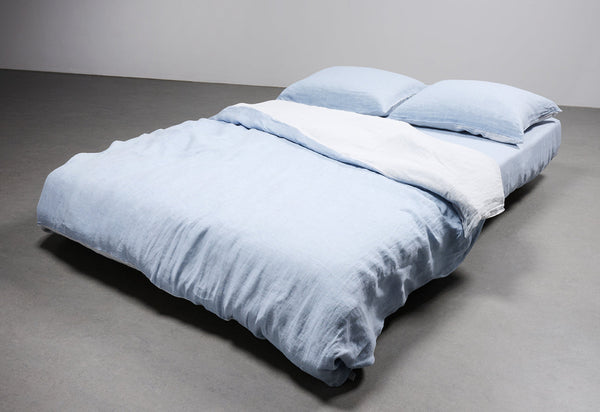
The Grey and Feather Grey set keeps the palette tonal, while Blue and Amber creates a clearer cool-warm dialogue. Light Grey and Rose Blush offers gentler contrast. Each current product page describes a reversible front and back that can be swapped or revealed by folding the duvet. The three are made from 100% Egyptian cotton at 600 thread count, yarn-dyed and woven in Italy, finished with a traditional boutis process, hand-finished, and certified to OEKO-TEX STANDARD 100 24CX00094. Check the live page for sizes and current care details before ordering.


Explore Collections

How to Style Two-Tone Bedding: Reversible Looks and Colour Pairings

Start with the Room, Not the Set

Before choosing which face should dominate, list the room’s fixed colours: wall, floor, headboard, wardrobe and the largest rug. Select one bedding colour that connects with this background, then let the second act as an accent. A grey wall may support Grey and Feather Grey for a quiet scheme, or Blue and Amber when the bed needs stronger presence. Repeat each bedding colour once elsewhere, perhaps in one cushion, a small artwork or a folded blanket, rather than matching every object. This creates continuity without making the room look staged. Browse the two-tone bedding collection to compare reversible linen and cotton options before settling on the balance.

Fold, Flip and Mix with Intention

Use one of three repeatable arrangements. For the quietest look, show one duvet face and keep every pillow on that colour, with only a narrow turn-back at the head. For a balanced two-colour composition, flip the front pillows and fold the duvet far enough to create one clear band. For a more expressive bed, alternate pillow faces, reveal a broader fold and add one solid sheet or throw that repeats either colour. Keep the number of additional hues low so the reversible pair remains legible. Tonal schemes depend on texture and small value shifts; complementary or warm-cool pairings need more neutral breathing space; high contrast works best when shapes and edges are simple. The earlier guide to two-tone linen and cotton bedding provides collection context.

Fold, Flip and Mix with Intention
ZigZagZurich

ZigZagZurich

Colour Should Move with the Way You Live

Explore artist

FROM THIS ARTIST / ZZ RECOMMENDATIONS

How to Style Two-Tone Bedding: Reversible Looks and Colour Pairings How to Style Two-Tone Bedding: Reversible Looks and Colour Pairings

Check the Palette in Day and Evening Light

Colour changes as the room changes. Before committing to one arrangement, view the bedding in morning daylight, weaker afternoon light and the lamps used at night. Cool north light can make blue and grey feel sharper; warm bulbs can deepen amber and blush. Photograph the bed from the doorway, because distance reveals whether one colour dominates too strongly. Then apply a five-step check: identify the room’s fixed neutral, choose the bedding colour that connects to it, decide how much of the second face should show, repeat each main colour no more than once elsewhere, and remove any accessory that introduces an unnecessary third or fourth hue. Minimal interiors usually benefit from one dominant face and a narrow fold. Playful rooms can alternate pillow faces. Art-led bedrooms can borrow one colour from a nearby work while leaving the other bedding tone independent. Revisit the arrangement seasonally by changing the visible face, not by replacing the complete scheme. Always select sizes and pieces from the live product pages, where duvet covers, sheets and pillow formats may be chosen separately.

YOUR CART IS EMPTY